第 06 章:Dropout——低内存随机失活
对应原仓库
07_dropout/dropout.py。这是全教程改动最小的一章,但演示了一个极其实用的省显存技巧:让掩码完全在 SRAM 里现场生成,绝不落 DRAM。
📒 本章对应源码(点击展开)—— 来源:07_dropout/dropout.py
python
"""
This tutorial on low-memory dropout required the least editing of all the original Triton documentation tutorials

What you'll learn:
- Parallel pseudo-random number generation
"""
import torch
import triton
import triton.language as tl

DEVICE = torch.device(f'cuda:{torch.cuda.current_device()}')

@triton.jit
def _seeded_dropout(
    x_ptr,
    output_ptr,
    n_elements,
    p, # a float32 probability, so range [0,1]
    seed, # a single int32
    BLOCK_SIZE: tl.constexpr,
):
    # compute memory offsets of elements handled by this program
    pid = tl.program_id(axis=0)
    offsets = pid * BLOCK_SIZE + tl.arange(0, BLOCK_SIZE)
    # load data from x
    mask = offsets < n_elements
    x = tl.load(x_ptr + offsets, mask=mask) # shape (BLOCK_SIZE)
    # the key insight is that we generate and use a mask entirely in SRAM without ever having to store it in DRAM.
    # this line generates uniformly distributed float32 values in [0, 1), given a seed and a block of int32 offsets
    random = tl.rand(seed, offsets) # shape (BLOCK_SIZE)
    # prune based on our desired probability threshold
    x_keep = random > p # values are either true or false
    output = tl.where(x_keep, x / (1 - p), 0.0)
        # where x_keep is True, the value is x/(1-p), and where False it's 0.0
    # write-back to DRAM
    tl.store(output_ptr + offsets, output, mask=mask)

def seeded_dropout(x, p, seed):
    output = torch.empty_like(x)
    assert x.is_contiguous()
    n_elements = x.numel()
    grid = lambda meta: (triton.cdiv(n_elements, meta['BLOCK_SIZE']), )
    _seeded_dropout[grid](x, output, n_elements, p, seed, BLOCK_SIZE=1024)
    return output

x = torch.randn(size=(8, ), device=DEVICE)
output1 = seeded_dropout(x, p=0.5, seed=123)
output2 = seeded_dropout(x, p=0.5, seed=123)
output3 = seeded_dropout(x, p=0.5, seed=512)
print(x, output1, output2, output3, sep="\n")1. dropout 在干什么
训练时,按概率 p 随机把一部分神经元置零(其余放大 1/(1-p) 补偿),防过拟合。朴素实现会先生成一个和输入同形的布尔掩码张量、存起来、再用。问题是:这个掩码张量本身要占一整份显存。
2. 朴素 vs seeded:省掉整份掩码
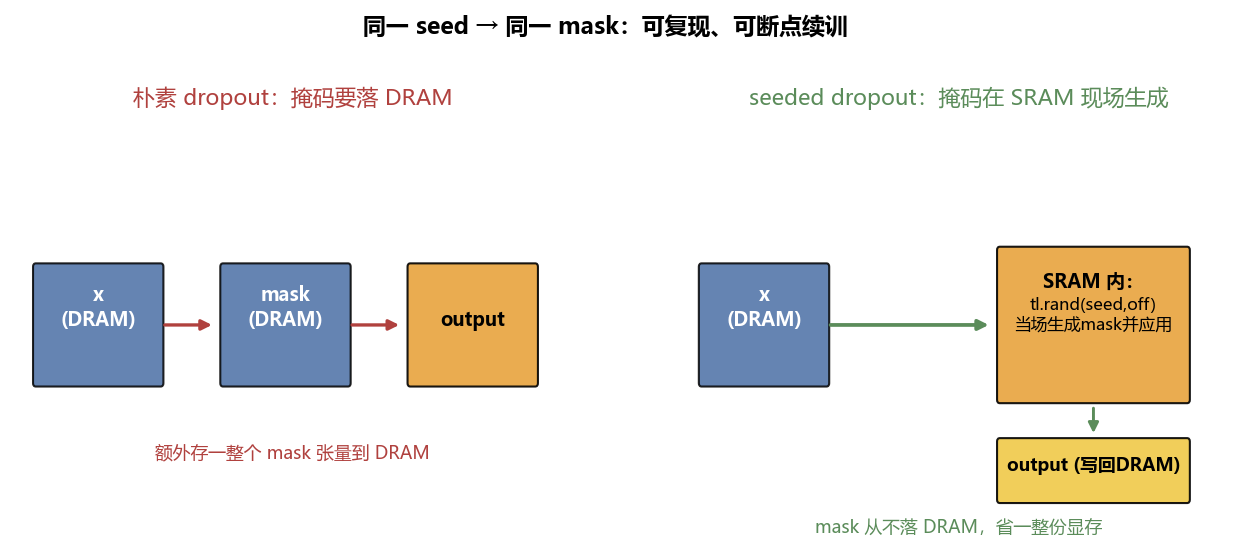
- 朴素:x(DRAM) → 读出 → 生成 mask 存 DRAM → 应用 → output(DRAM)。多存一份 mask。
- seeded:x(DRAM) → 读进 SRAM → 在 SRAM 里用 seed+偏移当场生成 mask 并立刻应用 → output(DRAM)。mask 从头到尾不落 DRAM。
3. 内核
python
@triton.jit
def _seeded_dropout(x_ptr, output_ptr, n_elements, p, seed, BLOCK_SIZE: tl.constexpr):
    pid = tl.program_id(axis=0)
    offsets = pid * BLOCK_SIZE + tl.arange(0, BLOCK_SIZE)
    mask = offsets < n_elements
    x = tl.load(x_ptr + offsets, mask=mask)                       # 读 x 进 SRAM
    random = tl.rand(seed, offsets)                                # ★ SRAM 内生成随机数 ∈ [0,1)
    x_keep = random > p                                            # 布尔掩码
    output = tl.where(x_keep, x / (1 - p), 0.0)                   # 留则放大,否则置 0
tl.store(output_ptr + offsets, output, mask=mask) # 写回 DRAM这章你已认识所有原语(program_id、arange、mask、load/store),重点就一个新东西:
tl.rand(seed, offsets):并行伪随机数
- 给一个
seed(int32)和一组offsets(int32 数组),生成与 seed 和位置一一对应的[0,1)均匀随机数,形状(BLOCK_SIZE,)。 - 关键性质:同一
(seed, offset)永远产生同一随机数 → 可复现。 - 完全在 SRAM 里算,不需要预生成、不需要从 DRAM 读 mask。
tl.where(cond, a, b):逐元素选择
cond 为真取 a,否则取 b。等价 PyTorch 的 torch.where。这里:保留的位置取 x/(1-p)(缩放补偿),丢弃的位置取 0.0。
为什么除
1-p?被丢弃的比例是p,留下1-p。要让输出期望不变,留下的要放大1/(1-p)倍。
4. wrapper + 演示
python
def seeded_dropout(x, p, seed):
    output = torch.empty_like(x)
    assert x.is_contiguous()
    n_elements = x.numel()
    grid = lambda meta: (triton.cdiv(n_elements, meta['BLOCK_SIZE']), )
    _seeded_dropout[grid](x, output, n_elements, p, seed, BLOCK_SIZE=1024)
    return output

x = torch.randn(size=(8, ), device=DEVICE)
output1 = seeded_dropout(x, p=0.5, seed=123)   # seed=123
output2 = seeded_dropout(x, p=0.5, seed=123)   # 同 seed → 同输出
output3 = seeded_dropout(x, p=0.5, seed=512)   # 换 seed → 不同输出
print(x, output1, output2, output3, sep="\n")可复现性的价值:
- 断点续训:保存 seed,重训时掩码完全一致,结果可复现。
- 调试:固定 seed 排查问题。
- 节省显存:大模型里掩码张量动辄几个 GB,省掉它意义巨大。
注意
assert x.is_contiguous():本内核按连续内存布局算偏移,非连续张量要先.contiguous()。
本章学到的
| 概念 | 要点 |
|---|---|
tl.rand(seed, offsets) | 并行 PRNG(Pseudo-Random Number Generator,伪随机数生成器),给 seed+位置生成可复现随机数,全程在 SRAM |
| 省显存 | 不物化掩码张量,省一整份 DRAM |
| 可复现 | 同 seed 同位置 → 同随机数,利于续训/调试 |
tl.where | 逐元素条件选择 |
缩放补偿 1/(1-p) | 丢弃后放大保留项,保持期望不变 |
小结
这章虽短,但"在 SRAM 里现算、不落 DRAM"的思路和第 04 章融合 softmax 是一脉相承的——都是减少 DRAM 读写。下一章我们终于要碰反向传播了:LayerNorm,它还引入了"原子锁"和"两阶段内核"。→ 第 07 章:LayerNorm